The Agentic Finance Landscape Report: Q3 2026 Edition
Written in collaboration with Cambrian teammates Brian, Doug, Pili, and Ricky.
Since we published the last edition of The Agentic Finance Landscape in early June, institutional signals have grown significantly, and our forecasts on the evolution of AI-augmented finance have closely followed what actually ended up playing out. Stablecoins and RWAs, including tokenized stocks, have been at the center of agentic finance adoption, with giants like Visa and Mastercard recognizing the role of stablecoins for machine-native micropayments,¹ while Solana, Base, and Robinhood are at the epicenter of blockchain innovation in agentic use cases.
Over the last quarter, Solana released Payment Channels, enabling agents to spend at scale. The Base ecosystem pivoted into agentic finance use cases,² with Coinbase, the institution behind Base, releasing Coinbase Advisor, the first SEC-registered agentic investment adviser, and Coinbase for Agents. Robinhood included agentic trading, tokenized stocks, and RWAs in the same product strategy, reporting that 100k+ customers had opened Agentic Trading accounts.³
Among the leading voices of the convergence between AI and finance, we echo Sandy Kaul, Head of Digital Assets and Innovation at Franklin Templeton, whose thesis is that we’re heading to a world where blockchain and crypto technologies become the foundational delivery layer for agents to perform activities such as transactions, payments, and identity verification.⁴
The Q3 2026 edition of our recurring agentic finance report surveys the landscape of autonomous products that help retail participants navigate finance. As before, we applied a strict bar for excellence: listed projects must be active and publicly available, with real users and live capital at work (with an exception for informational agents that don’t transact). Agents are categorized by product type.
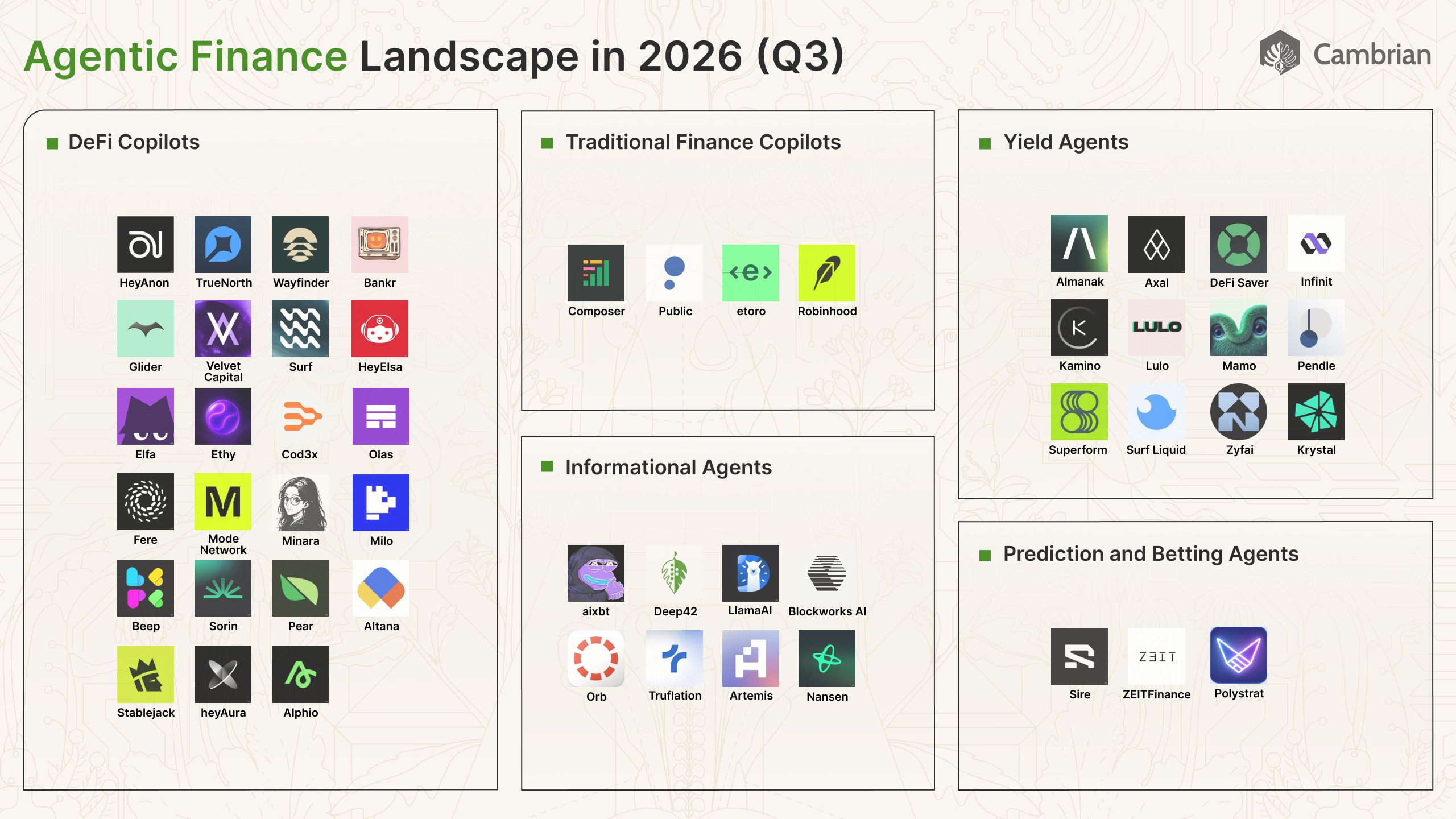
Jump down to learn more about each depicted project.
Table of Contents
- What is Agentic Finance?
- Autonomy vs. Intelligence in Agentic Finance
- AgentFi Market Growth in 2025-2026
- The Agentic Finance Landscape Q3 2026
- What’s next for Agentic Finance in 2026?
What is Agentic Finance?
As AI agents continue to take on a larger share of economic activity, agentic finance (AgentFi) has emerged as a market segment of products that use automation to actively manage users’ funds or provide financial advice. Inspired by ChatGPT, Claude, and rapidly growing open-source tooling, some of these products use LLMs, while others use hard-coded logic or traditional machine learning.
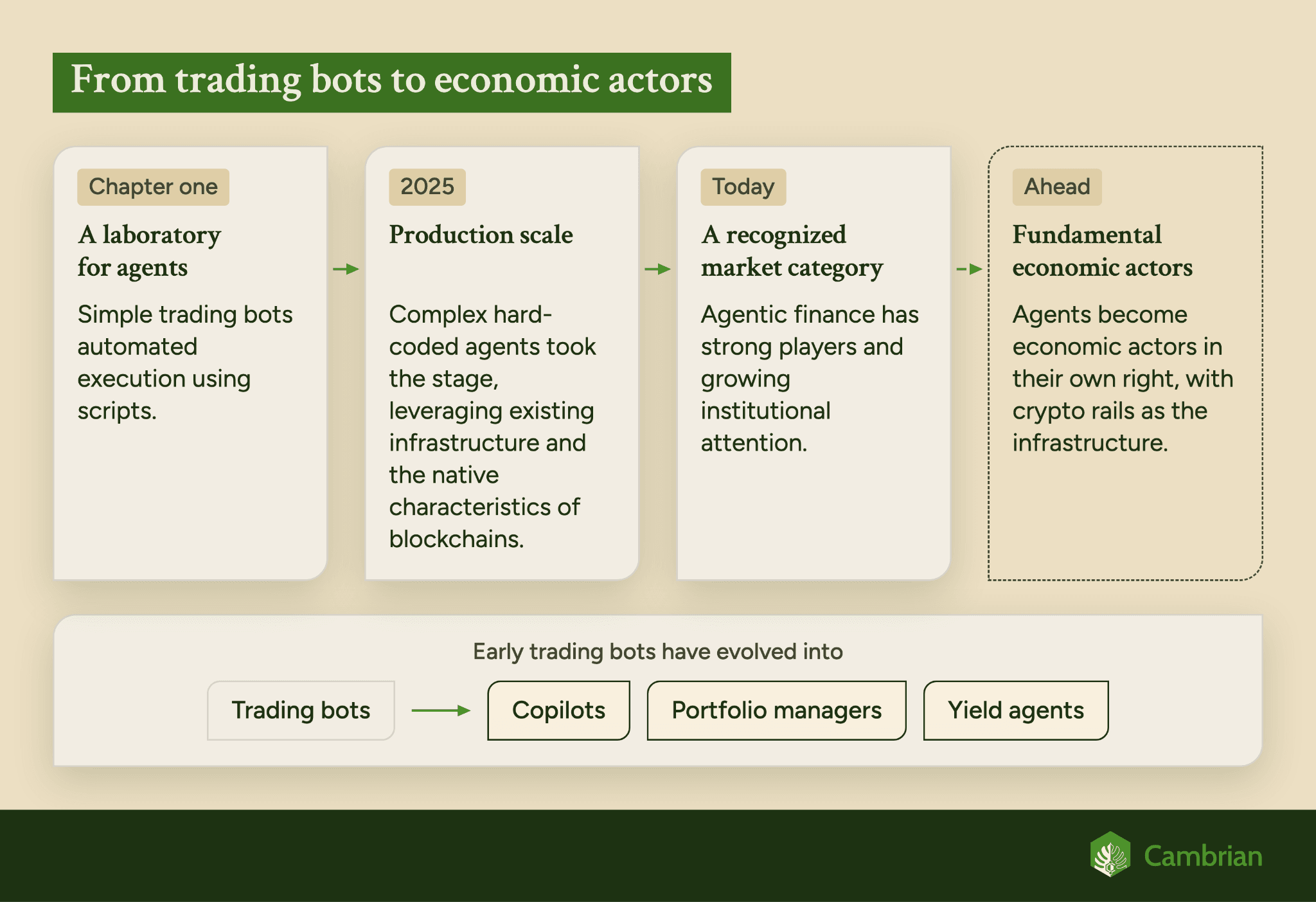
Looking back, the first chapter of the crypto industry served as a laboratory for agents with simple trading bots that automated execution using scripts. Later in 2025, that boundary shifted to production scale as complex hard-coded agents took the stage, leveraging the existing infrastructure and blockchains’ native characteristics. Today, agentic finance is a recognized market category with strong players and growing institutional attention. It’s clear we’re moving toward a world where agents become fundamental economic actors, with crypto rails as the perfect infrastructure.⁵ Early trading bots have now evolved into copilots, portfolio managers, and yield agents.
Agentic finance products span a wide range, and they’re constantly evolving. LLMs sit at the center of it all, acting as researchers, sentiment-analysis filters, strategy-creation assistants, and orchestrators. They’re rapidly becoming a copilot for every task. Hard-coded logic strengthens their execution capabilities, enabling strategy backtesting, technical analysis, looping funds through vaults, and other tasks that require determinism.
Integrating an LLM into a financial product without the right context, tool-calling, and integrations is futile in a space where major players compete with institutional-scale professionals and unprecedented speed. To compete best, AgentFi products must be highly specialized and focused on dominating a particular niche rather than trying to be generalized tools. This trend toward specialization is what we’ve seen manifest in the space, and we'll describe it in the following sections.
The products covered in this report represent the next major step in AgentFi’s progression: software that makes decisions, manages capital, and helps humans navigate financial markets. Regardless of the underlying tech, many of the projects listed describe themselves as “agentic.”
Autonomy vs. Intelligence in Agentic Finance
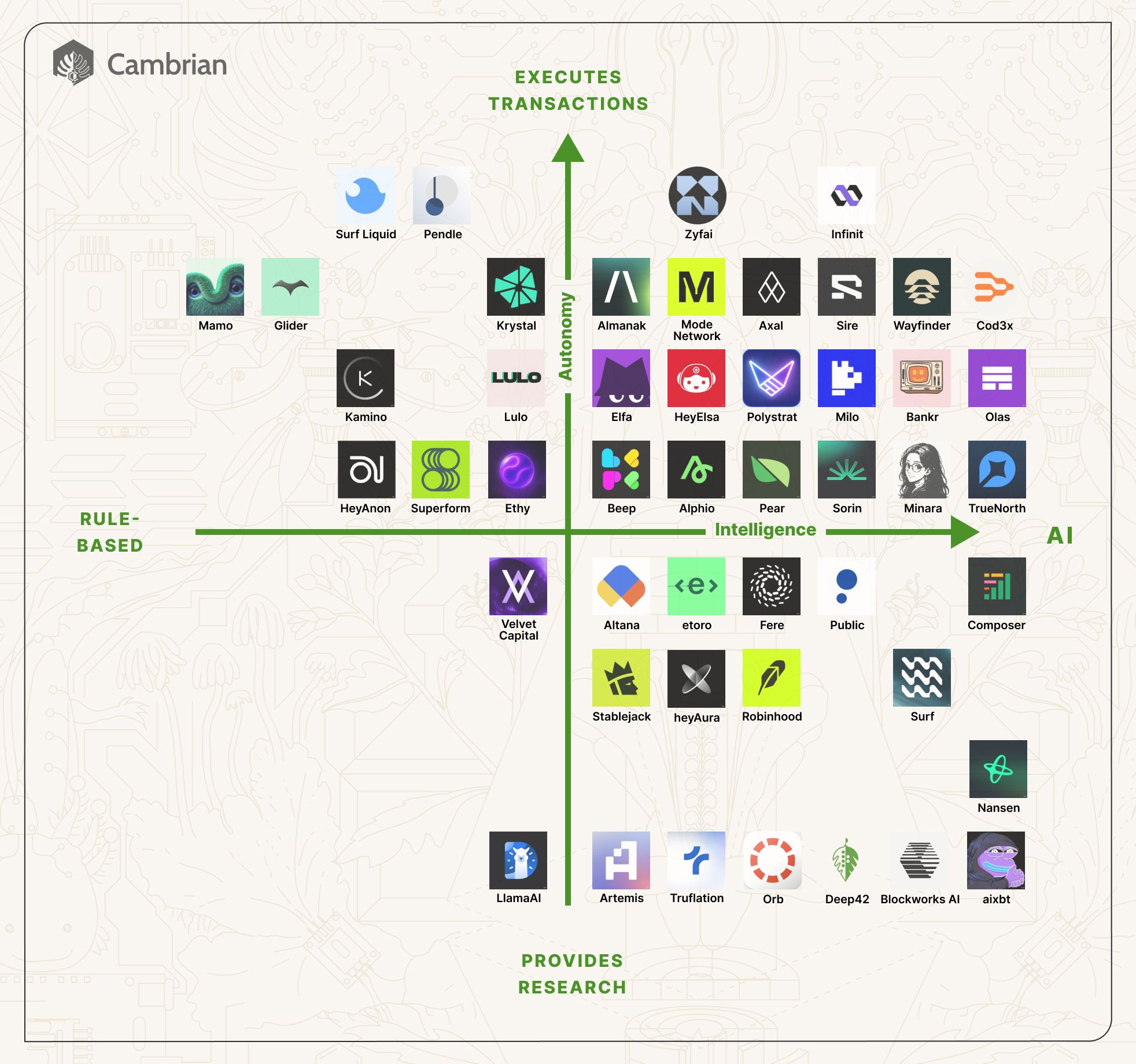
Agentic finance projects span specialized use cases, but you can place each project on a simple compass. On the x-axis is intelligence: on the left, hard-coded systems that rely on math, Boolean logic and statistics; on the right, LLM-based systems (what many now call “AI agents”). The y-axis represents autonomy, ranging from tools that inform at the bottom, to human-in-the-loop systems in the middle, to autonomous systems that execute within policy without requiring permission at the top.
Since the first edition of this report, the center of gravity has shifted upward toward greater autonomy, while products with the most assets under management remain on the rule-based side of capital allocation decisions. Informational agents in the bottom-right quadrant are also gaining popularity.
AgentFi Market Growth
Growth Metrics
Since our last report, the TVL of decentralized AgentFi products grew by around $10m, with most of it concentrated on Ethereum mainnet, Base, and Arbitrum (though Robinhood Chain is gaining momentum too). Among the leading projects by TVL, we see Zyfai, a rule-based yield-seeking agent; Krystal, a liquidity-farming agent; and Infinit, AI-managed trading vaults.
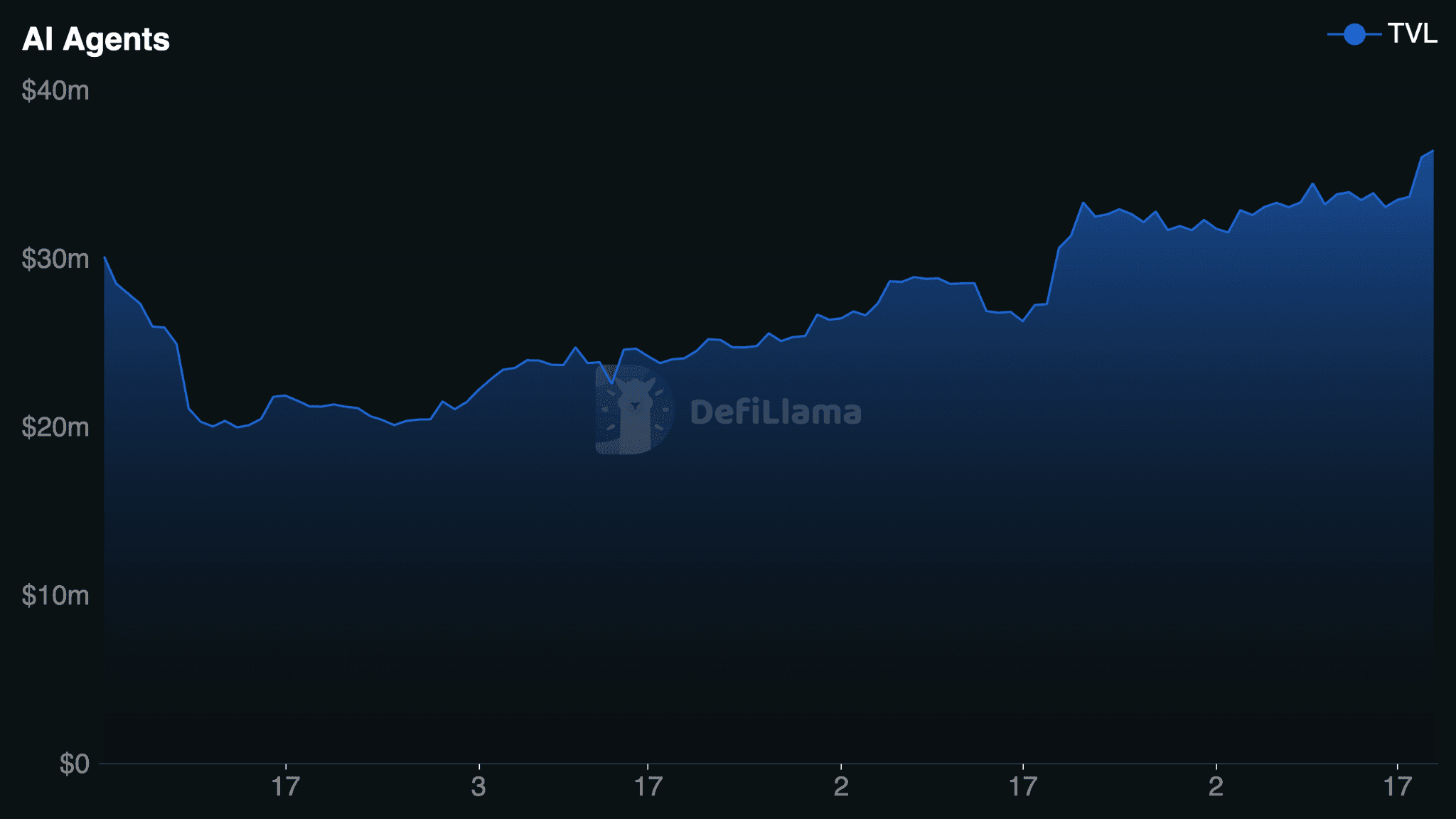
Source: https://defillama.com/protocols/ai-agents
Another indicator of growth is agentic payments, with x402 leading the way.⁶ Compared to AP2, MPP and ACP, x402 is at the forefront with 232m transactions and $54m of volume processed.⁷ MPP, the recently launched Machine Payments Protocol co-authored by Stripe and Tempo, has already processed 3.5m transactions and almost $500k in volume.⁸
If we look at ERC-8004 adoption, Agentscan reports 500k+ registered agents - doubling the number since last quarter’s report - with 143k+ agents active across 22 networks, including EVM and non-EVM chains such as Solana.⁹
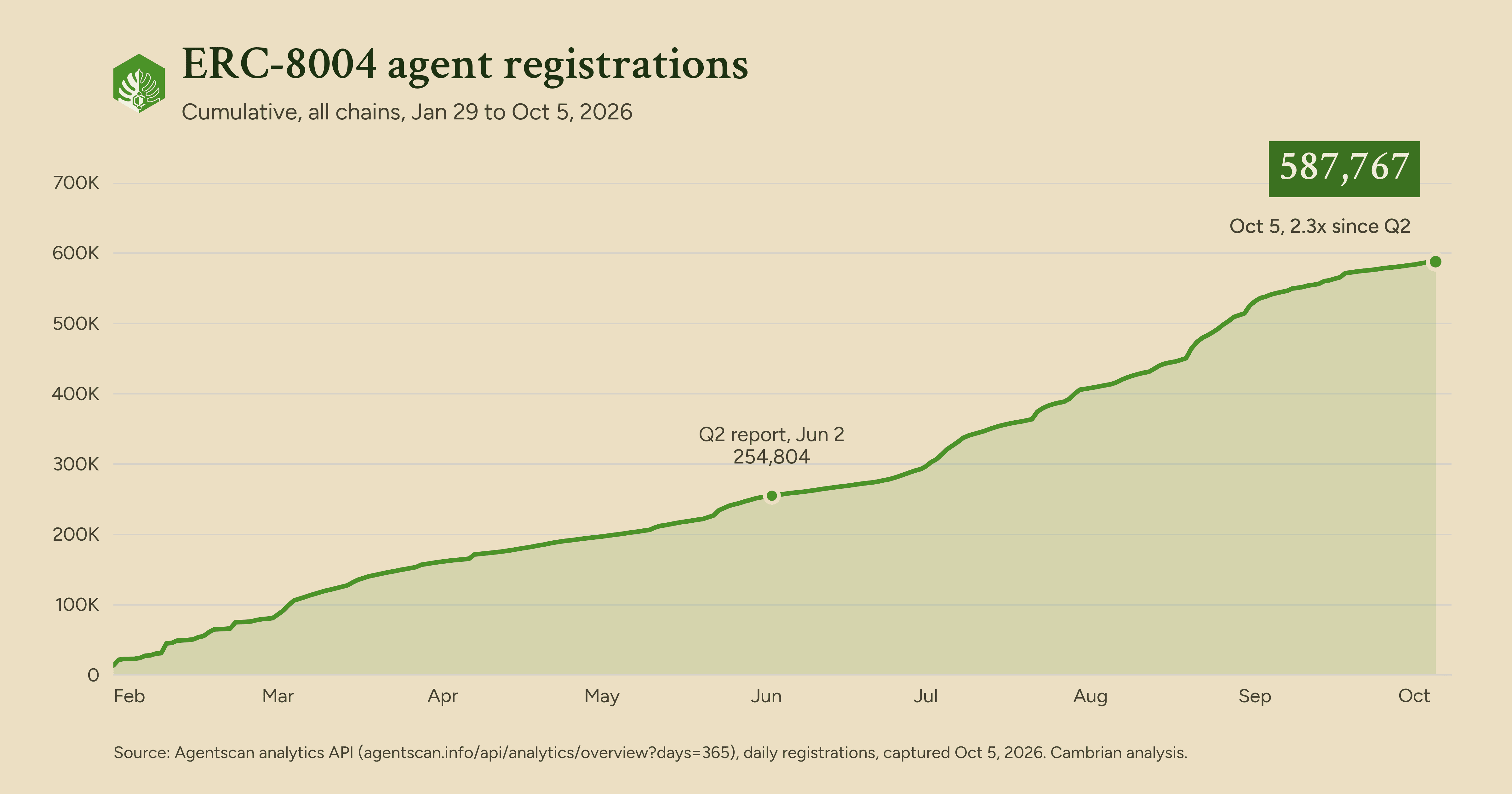
Source: https://agentscan.info/insights + Cambrian research
After a concerted effort around AgentFi adoption and announcing a plan to launch a new Layer 1 designed for agentic trading,¹⁰ BNB is leading the rankings for total net number of agents. BNB has registered over 300k agents, outpacing Base and Ethereum mainnet combined.¹¹
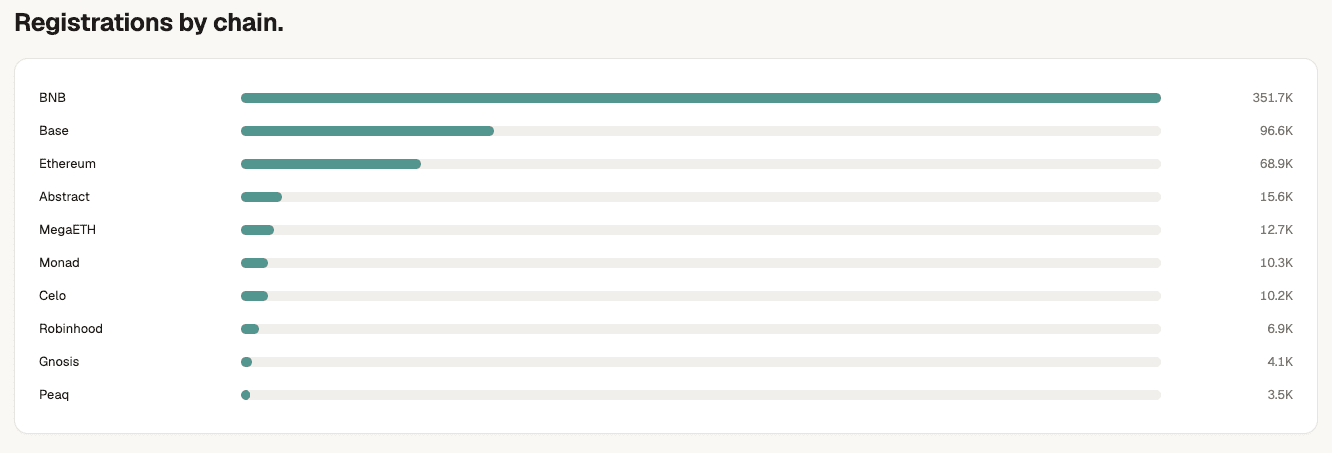
Source: https://dashboard.agenteconomy.to/erc-8004
The rapid growth in these ecosystems shows that builders are adopting shared infrastructure for agents. Though, one must take net agent registrations with a grain of salt, as they may not reflect total financial agents. A registration can be almost anything: an actual AI agent, a bot, a tool, or a one-time test. In an effort to qualify the various types of agent registrations across chains, we sorted all the registrations Agentscan listed on September 24, which were 576k at the time. The vast majority of these agents, about 73%, fall into the categories of trading bots, forecasting agents, or agents that perform a mix of ops, coding, and writing. About 27% (154k) have no usable description. BNB's lead comes mostly from apps that register an agent for every user: 259k of its 287k owners are associated with only one agent. By our count and public descriptions, about 7k registrations (~1%) claim to be financial decision-making agents, and at least 13.6k more are financial agents that provide information.
Emerging Trends
The most consequential AgentFi launches in Q3 were agentic accounts at regulated brokerages and exchanges. Some examples include Robinhood's Agentic Trading, eToro Agent Portfolios, Webull Agentic Trading, and the aforementioned Coinbase Advisor. They all follow similar patterns, reducing barriers to investment and exposing millions of users to the benefits of AI trading copilots.
General-purpose LLMs, like Grok, Claude Code, and Codex, are increasingly leveraging MCPs and skills to serve as trading copilots. Coinbase is breaking a new ATH in trading volume on Coinbase for Agents every week.¹²
Agentic trading is also gaining popularity among self-custodial users as wallets become the default interface to the financial world. MetaMask is leading the way with its new Agent Wallet, which allows users to connect their agents and configure predetermined rules for them to operate under. Major blockchains like Robinhood, BNB, and Base also continue to focus on agentic trading solutions across their product stack.
On the other hand, we have seen payment standards adopt metered billing, in other words, pay-as-you-go models without formal subscriptions. Coinbase released Upto, allowing buyers to authorize a maximum spend; Tempo added MPP Credits to enable card-funded agent wallets; and Arc, the blockchain Circle recently launched, released Nanopayments to enable permissionless, programmable, high-frequency agentic transactions.
Agentic payments have also been adopted by giants like Visa and Mastercard. Visa recognized the importance of crypto-native agentic payments that leverage stablecoins,¹³ mentioning x402 and MPP as the ones with the greatest adoption. They also recognized that crypto-native payments better suit machine-native micropayments rather than cards. Mastercard launched Agent Pay for Machines with 30+ partners, including Coinbase, Stripe, Tempo, OKX, Solana Foundation, and Polygon Labs.
Reflecting on a year of AgentFi, we also see a shift in agentic commerce, from speculative memecoin minting in the early days to financial and agentic services that are rapidly maturing.
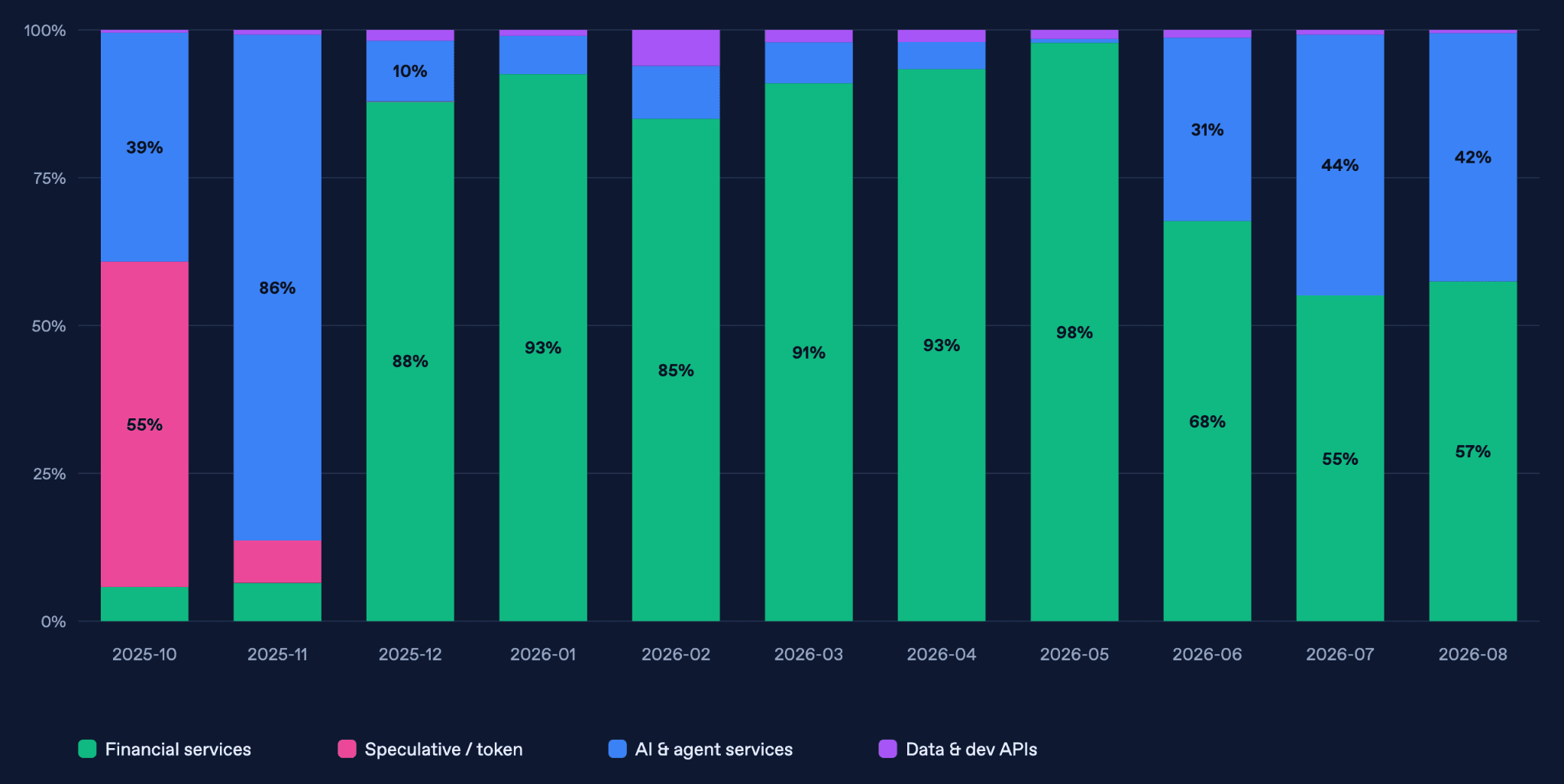
Source: https://www.trmlabs.com/trm-tech-blog/whos-actually-paying-measuring-ai-agent-payments-onchain
The Agentic Finance Landscape Q3 2026
Retail users are the early adopters of agentic finance, though as we’ve noted, institutions are increasingly entering the fray with new tooling or standalone projects. Below, we list the most legitimate retail-oriented AgentFi products.
Cambrian employs a strict filter for inclusion in the Agentic Finance Landscape: We don’t list projects still in development or in internal testing, nor those that use only an LLM interface but require humans to make the “hard” decisions. This ruled out many projects.
DeFi Copilots
Many users interact with Agentic Finance primarily through AI agent harnesses such as Claude Code, Codex, and Cursor. This broad category covers products that offer people a way to interact with AgentFi through a specialized, typically web-hosted UI using natural language.
DeFi copilots are the first product most people think of when they hear “agentic finance.” These agents provide research and also help manage users' funds by rebalancing portfolios or picking assets to buy or sell. Many offer automations like simple buy-and-sell, and some let users build and run more complex strategies. None of the products listed are fully autonomous yet. Most of these products trace their roots back to chatbots that can take action, but many have expanded their feature set. They are also multi-chain wallets, token launch platforms, agent skills builders, and no-code tools. As this broad category grows rapidly, we plan to segment it into subcategories in future updates.
Yield Agents
You can earn yield in AgentFi through many paths. The most popular at the moment is through lending protocols like Morpho, Aave and Euler, where borrowers pay interest, which lenders receive as yield. Users can also provide liquidity in DEX (Decentralized Exchange) liquidity pools to receive trading fees, or deposit funds into curated vaults that allocate capital across multiple venues. The agents below help users find the best risk-adjusted returns across these strategies.
Over time, we’ve found that more and more projects combine multiple yield-generating strategies, including but not limited to lending, LPs, and spot trading. This is because maintaining an edge in lending is difficult, with TVL mostly concentrated in a small bucket of top pools and current yields comparable to safe assets like U.S. Treasuries. We expect to see further adoption of more advanced approaches to pursue higher yields.
Prediction and Betting Agents
Prediction markets are platforms where users can bet on the outcomes of future events, such as election results or sports competitions. These markets often require tracking news and other real-world information that can unfold and change in unexpected ways in real time. Prediction markets are one of the most exciting emerging categories within AgentFi. Agents can consume and track real-world event information across a wider range of data sources than humans can manually, making them ideal participants in prediction markets.
We previously removed this category in our Q2 2026 report due to project inactivity at the time. We’re now reviving the classification in response to recent high-quality project launches, and because we now expect this segment to grow through 2027. Academic studies, such as this one from the Federal Reserve, are showing that prediction markets can provide decision-makers with valuable insights. Meanwhile, the CFTC is asserting its authority to legalize prediction markets over state objections.
Informational Agents
Investors often use market analysis to determine what to buy and sentiment analysis to decide when to buy or sell. LLMs have significantly transformed both market and sentiment analysis by scaling the amount and speed of data analyzed and by creating a deeper contextual understanding through connections between data sources.¹⁴ A key difference between analysis agents and the agents above is that they don't execute financial transactions; instead, they provide informative guidance. Many analysis agents spin up daily; we list only the most noteworthy below.
Traditional Finance Copilots
Similar to DeFi Copilots, Traditional Finance (often called TradFi) copilots are AI-powered research and trading assistants that execute on traditional brokerages rather than blockchains.
Many DeFi copilots offer exposure to equity markets through tokenized stocks and, more commonly, derivatives such as stock and pre-IPO stock perps. Many of these products are not available to U.S. users, but are becoming popular internationally for their ability to give access to U.S. financial instruments; some products navigate local regulatory barriers and can provide fiat onramp and offramp as well as a traditional trading experience.
What’s next for agentic finance in 2026?
We’re seeing two clear movements converging. On one hand, institutions are moving from pilots to real-world blockchain adoption, demonstrating clear appetite for 24/7 programmable markets. On the other hand, crypto-natives are sprinting to meet institutional requirements from banks, asset managers, and governments. This creates the perfect opportunity for agentic finance to thrive: billions in TVL from the institutional world are getting ready to move onchain to leverage trustless, 24/7 blockchain rails. In that context, agents are better suited to process data at scale and make optimal decisions when trading and investing.
A few examples, not exhaustive, of this convergence are DTCC (Depository Trust & Clearing Corporation) executing its first production trades with tokenized DTC-held securities;¹⁵ a group of twenty-one leading financial institutions (Bank of America, Citi, Goldman, UBS, Deutsche, MUFG) committing to establishing a new stablecoin company;¹⁶ Circle launching a full-stack platform for the agentic economy; BlackRock releasing a new tokenized market fund for stablecoin reserves;¹⁷ and Franklin Templeton announcing an integration between BENJI and Moonpay Trade, allowing eligible institutions to move between stablecoins and tokenized money-market-fund exposure.¹⁸
On the crypto-native side, BNB Chain is now ISO/IEC 27001 (information security) and ISO/IEC 27701 (privacy) certified;¹⁹ the same move is showing up at CoinMarketCap (SOC 1&2 and the same dual ISO) plus Ethena and Aave (SOC 2 Type II). Raising operating standards is a trend we predicted last quarter and is now underway among major players.
Projections for agent-mediated commerce converge on a range rather than a single figure. Among them, Juniper projects transaction value rising from $8 billion in 2026 to $1.5t trillion in 2030 and $3.5t by 2031, with 1.3 billion users,²⁰ while McKinsey estimates put agentic commerce at $3-$5 trillion by 2030.²¹ What is certain is that online commerce is on the verge of a Cambrian explosion of agents making online purchases, driving greater adoption of stablecoins and micropayments.
As the market prepares to support billions of agentic payments, crypto rails are better suited to agentic finance than traditional rails. Not just regarding payments,²² but also for tokenization²³ and 24-hour trading.²⁴ Echoing CFTC Chair Mike Selig, we expect onchain systems to handle a massive wave of tokenization, trading, and agentic finance in the near future.²⁵
Despite market volatility, institutional adoption continues to expand, primarily toward real-world assets (RWAs) and stablecoins, creating a breeding ground for AgentFi to scale with battle-tested infrastructure. The distributed value of RWAs has reached $38.6 billion this quarter.²⁶ Circle, a major stablecoin player, reported USDC onchain transaction volume in Q2’26 of $14.8 trillion, up 151% year-over-year.²⁷
Regulatory clarity and the convergence of AI, DeFi, and TradFi
The Convergence of AI, digital assets, and institutional finance is well underway, a phenomenon we covered extensively in our first-ever Convergence Report. One of the key unlocks for institutional participation in the world of digital assets is regulatory clarity. A considerable portion of the regulatory focus during Q3 was on the CLARITY Act, which failed to pass in the Senate in mid-September. This left room for the SEC and CFTC to establish clear rules to modernize federal securities regulations for crypto assets. Paul Atakins, SEC Chairman, highlighted the importance of providing greater regulatory clarity to keep the US as the crypto capital of the world, even without the CLARITY Act. ²⁸
This quarter, agentic payments became a named regulatory object for the first time in the UK, Korea and Singapore. The Monetary Authority of Singapore (MAS) released Singapore’s SAFR (Safeguards for Agentic Finance at Runtime), a paper proposing a new framework to enable agents to carry out financial tasks safely, securely, and reliably. Its co-authors include Circle, Visa, Mastercard, HSBC, and JPMorgan. In the UK, HM Treasury's payments consultation presented a dedicated chapter on how authentication, consent, and liability rules should change when agents execute payments.²⁹ Lastly, Korea updated its financial AI guidelines to anticipate agents paying for products and delegated authority.³⁰
As agentic trading grows, new rules for that market segment are emerging. Australia recently announced new guardrails around automated and AI-enabled trading after ASIC Commissioner Simone Constant shared that trading on Australia's markets is now almost entirely automated.³¹
What to expect for AgentFi in Q4 2026
As outlined in our previous reports, we continue to expect sustained growth in stablecoin adoption and usage, with corresponding growth in the most used standards, x402 and MPP.
We also anticipate agentic trading to continue to evolve, with centralized and decentralized platforms working hard on trading copilots, better wallet UX, and tools to bridge their stack to every agent (MCPs, CLIs, and skills). At scale, institutions, especially neobanks, will continue to care about agentic yield products.
We also reinforce the paradigm shift in how crypto natives used to operate and expect even higher security and privacy standards across the industry.
To stay ahead of the agentic finance curve:
- Sign up for the Cambrian newsletter to be notified of our next post.
- If you’re a developer building agentic applications, start using the Cambrian API for access to the best source of real-time and historical onchain and offchain financial data – built for agents, institutions and traders. Trade smarter, discover better yield, analyze risk, and much more with our API's 80+ endpoints.
Lastly, connect with me on X to share your ideas or to let me know if I’ve missed anything in the first edition of the agentic finance landscape.
About the author
Sam Green is the founder of Cambrian Network, the financial intelligence layer for agents, institutions and traders, backed by investors including a16z, Franklin Templeton and Polychain. Sam has been deeply embedded in AI for over 15 years, focusing on applying AI to crypto and finance over the last 5+ years. His recent career experience includes leading AI and verifiability for The Graph and co-designing Odos, a pioneering DEX aggregator. Previously, Sam was an AI and cryptography researcher at Sandia National Labs. Sam holds a master's degree in applied mathematics and earned a Ph.D. in computer science at UC Santa Barbara, where he also taught the university’s first reinforcement learning class.
About Cambrian
Cambrian is the financial intelligence layer for agents and institutions. Our API delivers real-time and historical blockchain data, covering yield, liquidity positions, risk, trading activity, and market sentiment, for agentic and institutional DeFi applications. Founded in 2024, Cambrian is backed by Polychain Capital, Franklin Templeton, a16z crypto, Flow Traders, Selini Capital, and others.
This content is for general information only and does not constitute financial, investment, legal, or tax advice. Accuracy is believed reliable at the time of publication, but is not guaranteed, and opinions may change without notice. You should conduct your own research and consult qualified professionals before making decisions. References to third‑party projects do not imply endorsement. The author and publisher accept no liability for any loss or damage arising from reliance on this material.
Sources
- https://www.visa.com/en-us/thought-leadership/innovation/agentic-payments-from-the-ground-up
- https://x.com/base/status/2086829928247365933?s=20 & https://www.mastercard.com/us/en/news-and-trends/stories/2026/converging-payments-ecosystem-policy.html
- https://investors.robinhood.com/news-releases/news-release-details/robinhood-reports-second-quarter-2026-results
- https://x.com/FTDA_US/status/2079527739288158472
- https://www.blackrock.com/us/individual/literature/whitepaper/the-machine-native-economy.pdf
- https://www.trmlabs.com/trm-tech-blog/whos-actually-paying-measuring-ai-agent-payments-onchain
- https://www.x402scan.com/all
- https://www.mppscan.com/
- https://agentscan.info/insights
- https://www.timesofblockchain.com/news/bnb-chain-layer-1-ai-agents/
- https://agentscan.info/agents?network=bsc-1
- https://x.com/CoinbaseDev/status/2105300138445197711?s=20
- https://www.visa.com/en-us/thought-leadership/innovation/agentic-payments-from-the-ground-up
- https://scholar.google.com/scholar?hl=en&as_sdt=0%2C44&q=can+LLMs+prove+financial+guidance&btnG=
- https://www.dtcc.com/press-releases/2026/dtcc-turns-tokenization-into-reality
- https://www.prnewswire.com/news-releases/group-of-leading-international-financial-institutions-to-establish-stablecoin-enterprise-302866318.html
- https://cointelegraph.com/news/blackrock-launches-tokenized-money-market-funds-stablecoin-reserves
- https://www.franklintempleton.com/press-releases/news-room/2026/franklin-templeton-and-moonpay-partner-to-expand-institutional-access-to-tokenized-money-market-funds
- https://www.bnbchain.org/en/blog/bnb-chain-now-iso-27001-and-27701-certified-by-bsi
- https://technode.global/2026/06/29/agentic-commerce-can-reach-1-3b-users-by-2031-juniper-research/
- https://www.mckinsey.com/capabilities/quantumblack/our-insights/the-automation-curve-in-agentic-commerce
- https://www.blackrock.com/us/individual/literature/whiSenatetepaper/the-machine-native-economy.pdf
- https://www.blockchain.com/blog/posts/blockchaincom-and-nyse-team-up-to-explore-tokenized-securities
- https://www.sec.gov/newsroom/meetings-events/roundtable-preparations-24-hour-trading
- https://x.com/WatcherGuru/status/2102825769739403386?s=20
- https://app.rwa.xyz/
- https://www.circle.com/pressroom/circle-reports-second-quarter-2026-results
- https://x.com/SECPaulSAtkins/status/2100256253645668860?s=20
- https://bratby.law/agentic-payments-accountability-gap/
- https://www.fsc.go.kr/eng/pr010101/87140
- https://www.briefs.co/news/australia-moves-to-bolstfocusinger-oversight-of-algorithmic-and-ai-t/